
Fulfill a contract
Fund labor, materials, or execution before customer payments arrive.

Working Capital Review
Understand how capital should support the business before it adds new pressure.

The Enterprise Revealed · 02
Working capital is not separate from the business. It sits inside the movement of inventory, contracts, receivables, payroll, and growth. The review begins by seeing those relationships as one operating system.
Revenue is not liquidity.
Inventory moves before it is sold. Contracts require execution before payment. Receivables mature on a different schedule than payroll, suppliers, and overhead. The correct question is not simply how much capital is available—it is how the capital should fit the operating cycle.

Begin with the purpose
Fund labor, materials, or execution before customer payments arrive.
Prepare for demand without consuming the liquidity needed to operate.
Align capital with the time between delivery, invoicing, and collection.
Protect payroll and essential expenses through a temporary cash-flow gap.
Add capacity before new revenue has fully entered the operating cycle.
Build reserves and inventory before the revenue cycle accelerates.
Evaluate whether current repayment pressure is constraining the business.
Examine the operating cycle before choosing a product or structure.
The architecture review
A preliminary review should reveal more than a product category. It should show where the need originates, what the business can support, and what must be resolved before financing advances.

What the capital must accomplish.
How cash enters, moves through, and exits the business.
What the company can support without creating new pressure.
How current debt and repayment cadence affect liquidity.
Whether the information needed for a serious review is available.

The first outcome
The first outcome is not a product. It is a clearer view of the enterprise, the pressure inside its operating cycle, and the structures worthy of closer examination.
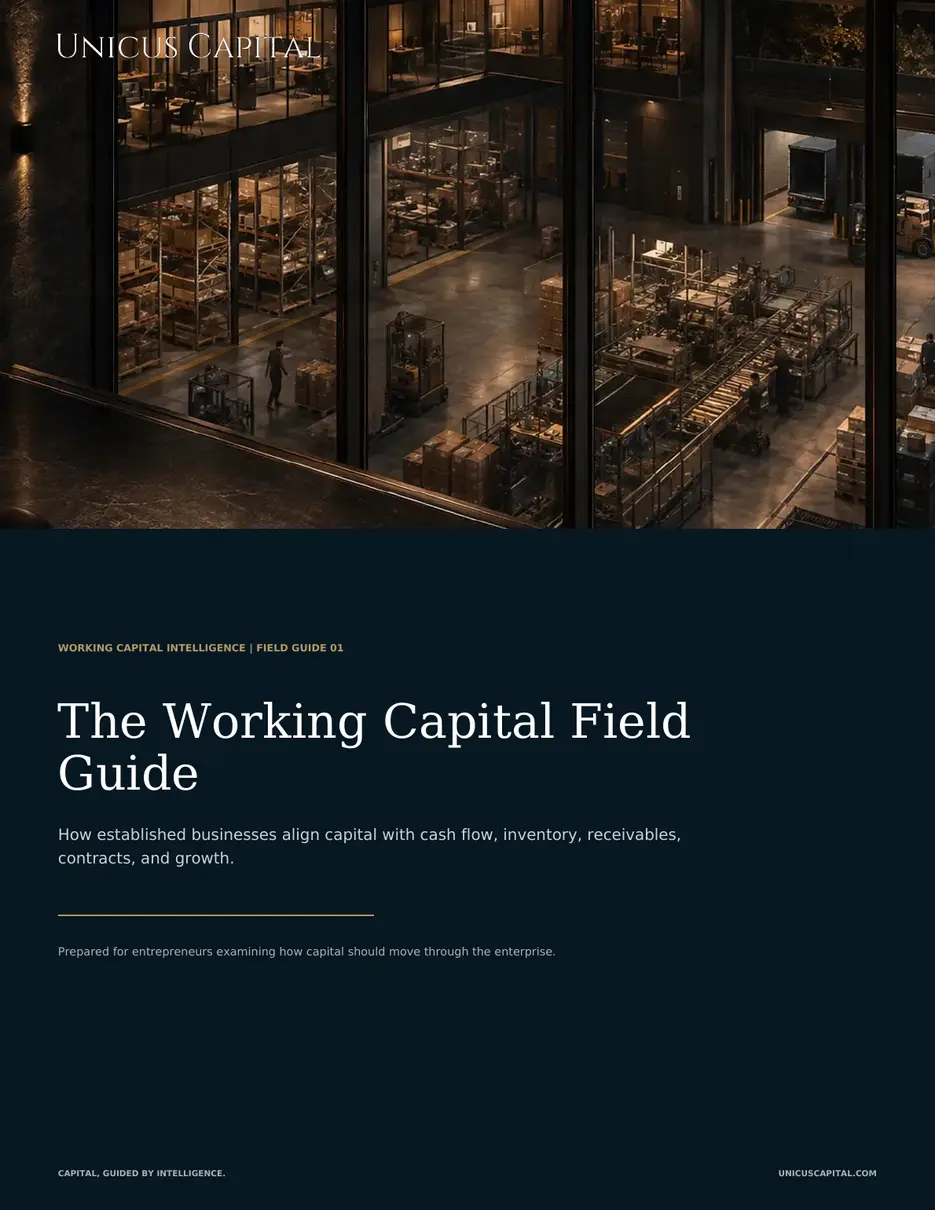
First · The Working Capital Field Guide
This 16-page field guide examines operating cycles, recurring and one-time needs, repayment cadence, lines of credit, term financing, receivables, inventory, contracts, and the warning signs of a structure that moves faster than cash enters the business.

The Clearing · 06
Before capital enters the business, understand how it should move through it.
Review the architecture ↓Capital Architecture Review
Receive the Field Guide by email and continue into a short, private review.